Center time is one the places that my students have a ton of practice with reading and writing sight words. While the beginning of the year starts with single words, we quickly move into simple sentences. A good way for students to practice forming compound sentences is to provide them with copies of simple books from early on in a reading scheme. Books for emergent readers are often written in simple sentences that form repetitive patterns that help children internalize various patterns of language. Help them develop their reading and writing skills as they practice tracing simple sentences using this fun worksheet. Even with two or more simple subjects, these examples are independent clauses conveying a complete thought, so they are still simple sentences.

Help them develop their reading and writing skills as they practice finishing simple sentences using this handy worksheet. Help them develop their reading and writing skills as they practice reading and tracing simple sentences using this helpful worksheet. Somewhere around age one or one and a half, the child will actually begin to utter single words with meaning.
These are always 'content' words likecookie, doggie, run,andsee- never 'function' words likeand, the,andof. Around the age of two, the child will begin putting two words together to make 'sentences' likedoggie run. A little later on, the child may produce longer sentences that lack function words, such asbig doggie run fast. At this point all that's left to add are the function words, some different sentence forms , and the more complex sound combinations .
By the time the child enters kindergarten, he or she will have acquired the vast majority of the rules and sounds of the language. After this, it's just a matter of combining the different sentence types in new ways and adding new words to his or her vocabulary. The special way in which many adults speak to small children also helps them to acquire language.

This 'baby talk' has simpler vocabulary and sentence structure than adult language, exaggerated intonation and sounds, and lots of repetition and questions. All of these features help the child to sort out the meanings, sounds, and sentence patterns of his or her language. After kindergartners learn their letters, sight words, and phonics, they get to put their new skills to the test by writing sentences.

Ease this tricky transition with our kindergarten writing worksheets that build confidence in young writers with an array of lessons that educate and fascinate. With cool animal illustrations and simple prompts, your budding author will love flexing their creative, vocabulary, and penmanship muscles with our kindergarten writing worksheets. All of these examples still qualify as simple sentences, because they are all independent clauses that convey a complete thought. Remember, basic simple sentences are the first type of sentence we learn how to write. So it's probably safe to assume that filling our writing with three or four word sentences is not the best idea. Too many simple sentences close together can sound choppy and disconnected.

Always revise your work to see where simple sentences can be edited to create more sophisticated writing. Again, these examples are all independent clauses conveying a complete thought. So even with multiple verbs, a sentence can be a simple sentence. But, before we begin to examine these different types of structure, we need to ensure our students understand the difference between independent and dependent clauses. Understanding clauses and how they work will make it much easier for students to grasp the different types of sentences that follow.

The simple sentence is one of four sentence structures, all of which are shown below. Modifiers, compound subjects, and compound verbs/predicates can be used in simple sentences. The more astute among your students may well be able to work out that a compound-complex sentence refers to joining a compound sentence with a complex one. More accurately, a compound-complex sentence combines at least 2 independent clauses and 1 dependent clause.
To set up this center, I begin by printing and laminating the sentence strips. I like to punch a hole in the corner and put them on a ring so that they all stay together. It makes it super easy for the students to grab what they need and put them away when they are done. When we focus on a specific short vowel sound, I will use the sentences to review those words.
Where To Use Go In A Sentence But as we learn more short vowel words, I love to mix them all up so that students get practice for all the short vowel sounds. The purpose of this article is to inform teachers and students about writing great sentences for all text types and genres. I would also recommend reading our complete guide to writing a great paragraph here. In both of these articles, you will find some great advice, teaching ideas, and resources. Kids rewrite incorrect sentences to gain practice with sentence structure, capitalization, and punctuation on this first grade reading and writing worksheet.

By the time a child reaches grade 4 or 5, it becomes extremely easy for them to create simple sentences. Creating simple sentences such as following are taught from the very young age and children are very good at creating them as it involves no complexities. When I first introduce this as a new center in our classroom we practice together. This gives me the opportunity to model what the activity should look like. By teaching them the procedure I want them to use, I can make sure that they are getting all the skills practice possible out of these simple sentences. Have you ever thought about the fact that reading and writing are opposite activities just like addition and subtraction.

With opposite activities working on one helps to strengthen the other. That's why it is important to give students opportunities to work on writing and spelling sight words, too. Now comes the fun part…using the Read & Reveal simple sentences!
The great thing about this activity is the instructions are very straightforward, making this an activity that students can be successful at independently. A compound-complex sentence with "zoo" contains at least two independent clauses and at least one dependent clause. To create a sentence frame, start with the end goal in mind.
What are you wanting your students to get out of using them? Before creating your structures, decide what your focus will be. Do you want your ELLs to learn specific vocabulary or just learn how to structure an answer? Once all of that is decided, consider their language level and what type of sentence you should present them with.

Next, go ahead and create the sentence structures, leaving blanks where you want the students to provide their thoughts. Use simple structures and words with beginning ELLs, and make the language more complicated as students become more advanced. Finally, creating a word bank can be especially helpful for students in the early stages of English-language acquisition. Subordinating conjunctions join dependent and independent clauses together. They provide a transition between the two ideas in the sentence.
This transition will involve a time, place, or a cause and effect relationship. The more important idea is contained in the sentence's main clause, while the less important idea is introduced by the subordinating conjunction. The first sounds a baby makes are the sounds of crying. Then, around six weeks of age, the baby will begin making vowel sounds, starting withaah, ee,andooh. At about six months, the baby starts to produce strings of consonant-vowel pairs likebooandda.

In this stage, the child is playing around with the sounds of speech and sorting out the sounds that are important for making words in his or her language from the sounds that aren't. Children acquire language in stages, and different children reach the various stages at different times. The order in which these stages are reached, however, is virtually always the same.

Help your first grader build his reading and writing skills with this beginner's writing worksheet. Rearrange the jumbled words to make a complete sentence. That's why I've pulled together all of my sight word practice activities into one Sight Words Mega Bundle! With the activities in this bundle you can fill your lesson plans all.year.long with fun and engaging sight word practice activities your students will love.

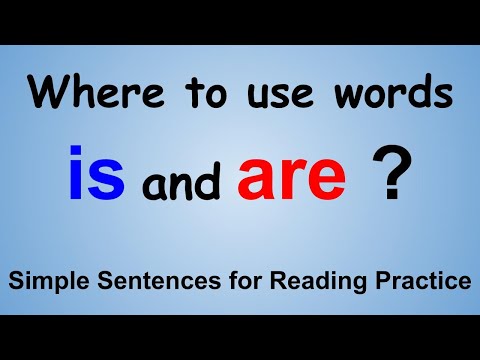
A simple sentence with "zoo" contains a subject and a verb, and it may also have an object and modifiers. With sentence frames, students can focus on the content because the correct sentence structure is already written for them. To use them properly in your writing, let's practice identifying them. Remember, a simple sentence is a sentence that contains one independent clause, or one complete thought.

Our reading resources assist parents, teachers, and other educators in helping struggling readers build fluency, vocabulary, and comprehension skills. Working in pairs or small groups, have the students identify and mark the independent clauses and dependent clauses in each sentence. When students can do this confidently, they can then begin to attempt to compose their own sentences. When complex sentences are organized this way , you'll note the comma separates the dependent clause from the independent clause.

If the structure is reorganized to place the independent clause first, with the dependent clause following, then there is no need for this comma. On the first run-through, have students identify and highlight simple sentences in the text. Then, students should use various colors of pens to pick out and underline the subject, the verb, and the object in each sentence. After a little practice, students will become adept at recognizing SVO sentences and forming their own. It's important to point out too that simple sentences don't have to necessarily be short. Simple sentences are, unsurprisingly, the easiest type of sentence for students to grasp and construct for themselves.

Often these types of sentences will be the first sentences that children write by themselves and they follow the well-known Subject – Verb – Object or SVO pattern. To promote language development during this stage model good speech habits by speaking clearly, looking at them in the eye, not interrupting, and giving them a chance to talk. You can also add on to what they say to give them an idea of more complex ways to articulate their ideas and requests. Ask your child lots of questions and encourage their questions too to keep the dialog going.

For example, it appears that all languages use the vowel soundsaah, ee,andooh- the same vowel sounds a baby produces first. Actually, she hasn't 'gone back' at all; she's gone forward. When she used the wordfeetas a toddler, she was just imitating what she had heard.

But now she has learned a rule for making plurals, which is that you add thessound to the end of the word. So she's just applying her new rule to all nouns - even the exceptions to the rule, likefoot/feet. She'll probably do the same thing when she learns to addedto verbs to make the past tense, saying things likehe standed upuntil she learns thatstand/stoodis an exception to the rule.
She'll sort it all out eventually, but for now, rest assured that this is progress; it's evidence that she's going beyond imitation and actually learning the rules of the English language. Typically developing children tend to begin learning language by first understanding and using single words, and then they gradually string them together to make phrases and sentences. Sentences like these are a piece of cake for children to make. However, they stumble when asked to create longer sentences.

One very easy technique to expand sentences is to join two simple sentences. Here is an example of joining two simple sentences to form one longer sentence. A complex sentence with "zoo" contains at least one independent clause and at least one dependent clause. Dependent clauses can refer to the subject the sequence/time , or the causal elements of the independent clause.
Your child rarely asks questions or often lets adults do most of the talking, speaks only in short phrases and sentences, or seldom adds additional information to a story. While flashcards, worksheets, and hands-on sight word activities all play an important role, practicing sight words in the context of reading is vital to building sight word mastery. In addition to being able to focus on the content, when using sentence frames, students will also pick up on correct English grammar and sentence structures to use in the future. ELLs can learn more easily by good modeling and repetition.
If you have a string of very basic simple sentences in your writing, you can probably combine some of those sentences into compound sentences. A simple sentence is a sentence containing only one clause, or more specifically, an independent clause, with a subject and a predicate. The main parts of speech that students must have an understanding of when utilising the ideas in this blog are nouns, adjectives, verbs, and adverbs. Dependent clauses, on the other hand, are not complete sentences and cannot stand by themselves. To become complete, they must be attached to an independent clause.

Dependent clauses are also known as subordinate clauses. Your toddler and preschooler is now using full words, simple sentences, and eventually more complex dialog. Overall, there are three stages of language development, which occur in a familiar pattern. So, when children are learning to speak, understand, and communicate, they follow an expected series of milestones as they begin to master their native tongue. However, note that individual children will progress at their own pace along this timeline within an expected range of deviation. Use a comma before an "and" (or "but," "or," etc.) that joins two independent clauses (i.e., clauses that could stand alone as sentences).

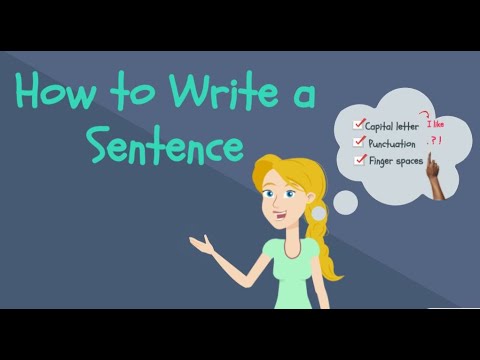
The job of an editor is to take a body of work and make that work more affective. Their main mission is to capture their audience and focus them on what is being presented. When constructing a sentence, you want to make it clear and meaningful for the reader. You want to get a complete thought projected while following proper capitalization and punctuation standards.


No comments:
Post a Comment
Note: Only a member of this blog may post a comment.